
The Next Computing Platform Is Space
Miklos Tomka argues that the next wave of innovation in space will come not from building better spacecraft, but from the software platforms that let thousands of organizations build applications on top of them.

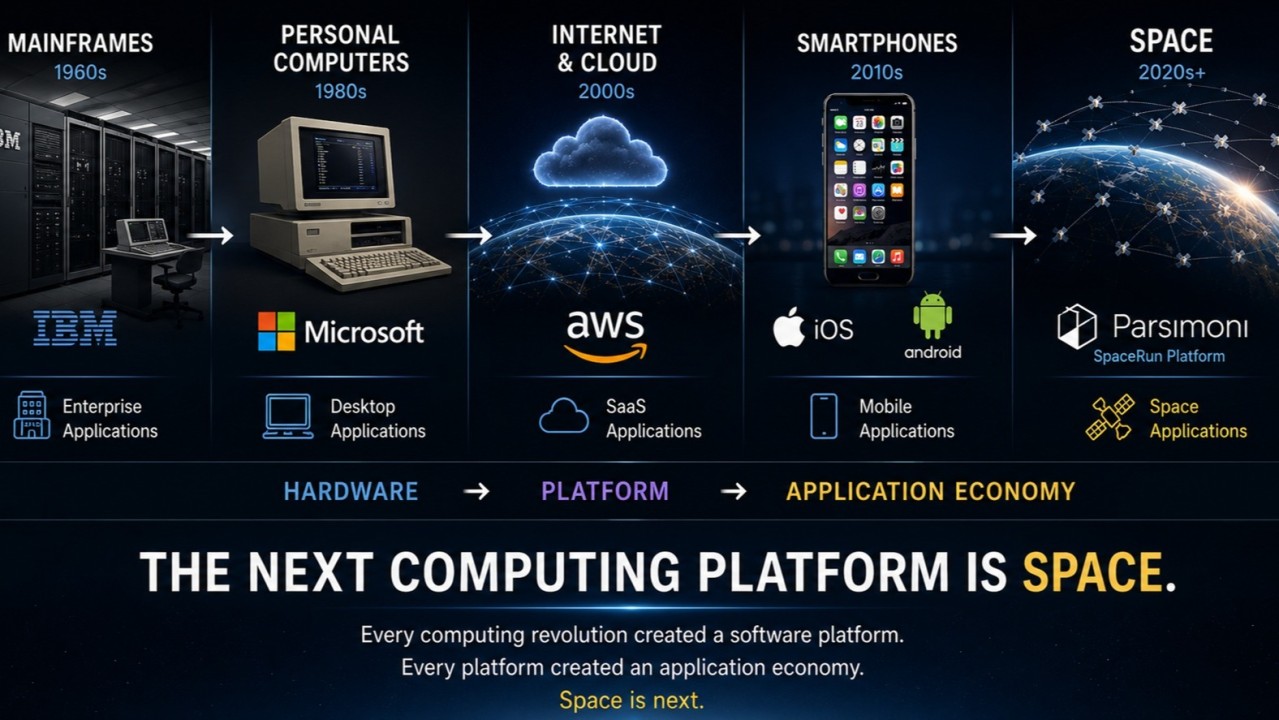
Every major computing revolution has followed the same pattern. It begins with advances in hardware, but the greatest value is rarely created by the hardware itself. Instead, it emerges when a common software platform enables an ecosystem of developers, businesses, and entrepreneurs to build applications that were previously impossible.
We've seen this happen repeatedly over the past fifty years. Mainframes enabled enterprise software. Personal computers created the desktop software industry. The Internet gave rise to cloud computing and SaaS. Smartphones transformed entire industries only after iOS and Android allowed millions of developers to build applications on a common platform. In every case, the hardware laid the foundation, but the software platform unlocked the ecosystem that created the greatest long-term economic value.
I believe the space industry is now approaching the same inflection point.
For decades, satellites have been remarkable engineering achievements, but they have largely remained bespoke systems, with each mission built around its own hardware, software, and development environment. That approach made perfect sense when satellites were expensive, produced in small numbers, and rarely changed after launch. Today, however, the economics of space are changing rapidly. Launch costs continue to fall, constellations now consist of hundreds—and increasingly thousands—of satellites, onboard computing power is growing dramatically, and artificial intelligence is beginning to move into orbit.
Satellites are no longer simply collecting data and transmitting it back to Earth. They are becoming powerful computers in space. Yet while the hardware has evolved dramatically, the software model has changed surprisingly little. Applications are still frequently written for individual spacecraft, software remains tightly coupled to specific hardware, and operators continue to solve many of the same engineering challenges repeatedly rather than building on a common foundation.
Much of today's discussion focuses on software-defined satellites, and rightly so. However, I believe software-defined satellites are not the destination—they are the first visible sign of something much larger. They represent the beginning of a platform shift that has accompanied every previous computing revolution.
History suggests that once hardware becomes sufficiently capable and widely deployed, value inevitably migrates higher up the technology stack. The next generation of innovation is no longer driven primarily by building better hardware, but by creating the software platform that allows thousands of others to innovate on top of it. The question is no longer whether satellites will become software-defined; the more important question is what that transformation will enable.
The smartphone revolution provides perhaps the clearest example. The greatest economic value was not created by the phones themselves, but by the application economy that emerged once developers had a common platform on which to innovate. Ride-sharing, mobile banking, food delivery, streaming services, and countless other industries were created not by smartphone manufacturers but by developers building on top of a shared software platform.
Platforms do far more than improve technology.
They multiply innovation.
There is little reason to believe that space will follow a fundamentally different path.
As satellites evolve into a distributed computing infrastructure, common software platforms will make applications portable across different spacecraft, allowing developers to focus on solving new problems rather than rebuilding the same underlying infrastructure for every mission. That transition has the potential to unlock an entirely new space application economy, in which organizations build services for orbit as naturally as they build applications for smartphones or the cloud today.
In my view, this is where the next wave of value creation in the space economy will occur—not simply because satellites become more powerful, but because a common software platform will enable thousands of organizations to innovate on top of them.
At Parsimoni, this belief is the reason our company exists. We are building the secure, hardware-agnostic software platform that we believe will help enable this transition and provide the foundation upon which the future space application economy can emerge.
Whether that future is realized will not depend on one company alone. Like every previous computing revolution, it will require an ecosystem of satellite manufacturers, operators, software developers, researchers, governments, and investors who recognize that the next chapter of the space economy will be defined not only by better hardware, but also by the platforms that enable others to innovate.
The next computing platform is space.
Let's build it together.